Mathematical models for speed climbing applied to data collected on competitors in recent World Cup events
MathSport International, Luxembourg, June 2025
Abstract
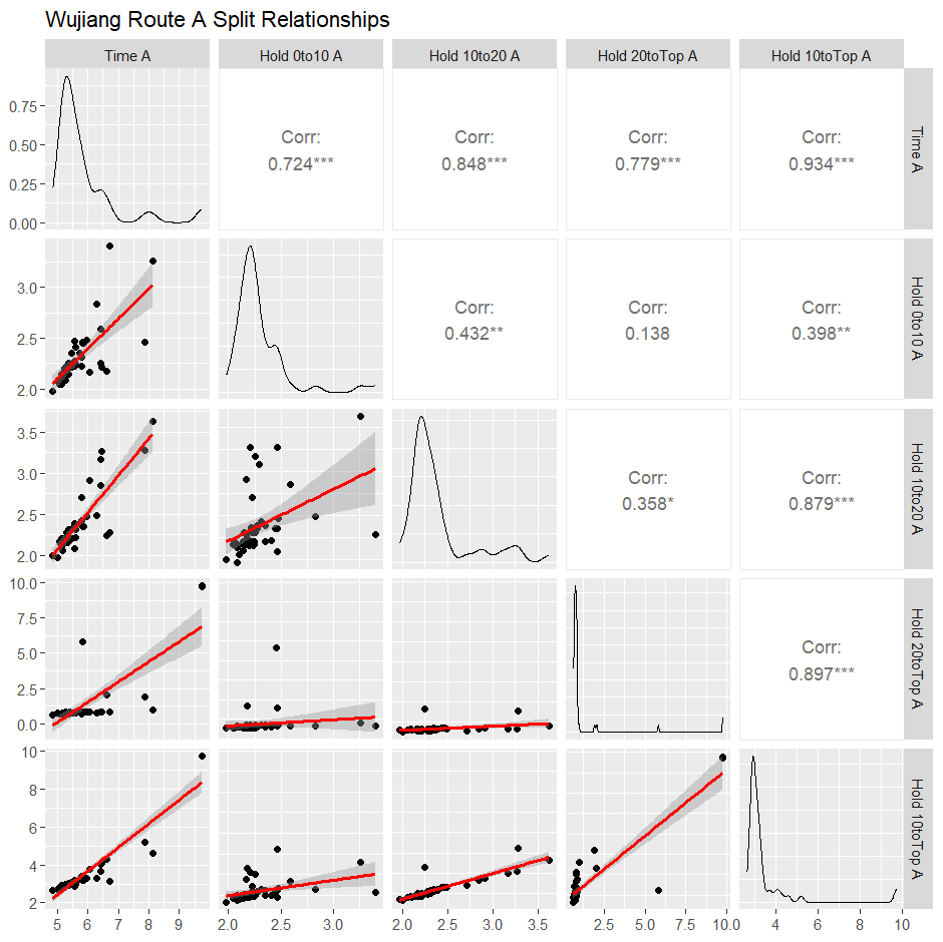
Speed climbing is one of the newest Olympic sports, debuting at the 2020 Tokyo Olympics. With many races decided by hundredths of a second, speed climbing quickly gained recognition as the fastest sport at the Paris 2024 Olympics. Speed climbing appeals to data scientists since it uses a standardized 15-meter wall, making it easy to compare times and strategies across a vast array of competitions and competitors. Surprisingly, however, there has been little rigorous analysis of a professional level race to the best of our knowledge. In this paper, we model data compiled from the 2023 World Cup events in Wujiang, China and Salt Lake City, USA, analyzing both numerical and categorical variables. Examples of quantitative variables include the reaction time displayed in the video for each athlete, along with the total time, or split times, obtained by running the recording for each athlete frame by frame and estimating the exact point at which each section is reached. An example of a binary variable is the skips strategy, which draws attention to the holds each athlete omits on their run. Another example of a categorical variable is the round designation – either round 1 or round 2 – which refers to the order of athletes’ runs. We explored these variables extensively, built several general linear models for athlete performance and used model selection to determine the best predictive models. We found that reaction times are normally distributed and appear to be very weakly correlated from one race to another. Counter-intuitively, however, they appear to have minimal bearing on the race result, despite making up a portion of the overall time. Another interesting observation is that many athletes attempt a more aggressive skip strategy in their second run, omitting a greater number of holds. This is either because they either already recorded a viable time for qualification in Round 1 and can afford the risk, or because they felt the need for substantial improvement. In ongoing work, we have been focusing on expanding the analysis, using data from additional World Cup events for both men and women.
 Luca Benga